In May of 2025, the Town of Basalt held a series of contested public hearings on a potential $2,532 per bedroom per year fee for short term rental (STR) operations in order to generate revenue for affordable housing. The fee was approved by a vote of 4-3, but not without hours of debate between councilors and dozens of citizens coming to the podium to voice their support for or concerns with the new measure. Town staff were directed to hold off on charging the fee until the new year began. For at least one household, the new fee has stretched their finances too far.
From Berlin to New York, housing studies have found correlations between STRs and decreased housing availability and increased rents. It intuitively makes sense — one bedroom held for tourists is one less bedroom available for the local workforce, and in the Roaring Fork Valley, tourism can be highly lucrative. However, due to those very housing costs, income from STRs is the only thing keeping some locals afloat.
Michael Schoepe and his husband, Paul Dankers, have been a part of the Roaring Fork Valley’s community for many years, closely involved with the Aspen Choral Society, VOICES, Challenge Aspen and other organizations as a pair and individually. In 2024, the two became music co-directors at the Two Rivers Unitarian Universalist congregation. For years they have worked long hours to make ends meet, while offering rooms in their home for both an STR and long-term rentals.
Schoepe was one of multiple Basaltians who came to the podium during last May’s public hearing to voice concerns about the proposed STR fee. Schoepe, like others, communicated to Town Council that his STR operation made life in Basalt possible, and that a new fee on top of the current cost of living would be the proverbial “straw that breaks the camel’s back.” That prediction has become reality, and Schoepe and Dankers have made the difficult decision to sell their home and leave Basalt indefinitely.
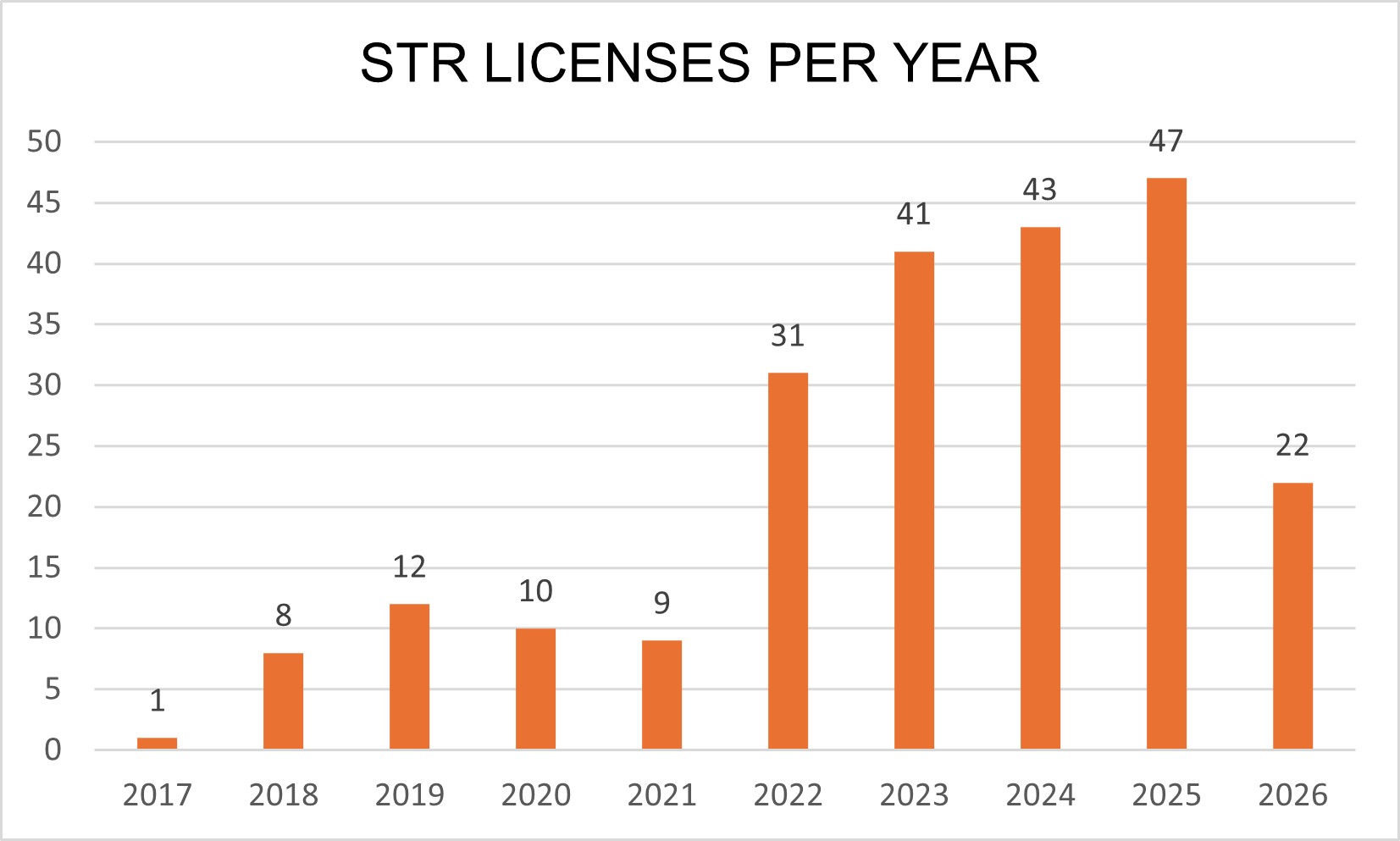
Basalt’s first STR license was issued in 2017. In the four years before and during the COVID-19 pandemic, Basalt issued an average of 9.75 STR licenses per year. In 2022, the number of licenses tripled to 31. The quantity steadily increased in subsequent years, peaking in 2025 at 47 licenses.
In response, Town Council attempted to address affordable housing needs via a flat per bedroom per year fee for STRs. Town Staff and Council landed on a $2,532 rate based on a study by Economic and Planning Systems (EPS) which stated that this value was half of the maximum amount that could be charged. EPS calculated this total value measuring the gap between the housing local employees can afford and the average cost of housing in Basalt.
As of Feb. 9 of this year, only 22 licenses have been issued, 20 of which are renewals. While data is unavailable for how many bedrooms are being rented per license, a majority of Airbnbs listed online in Basalt are only one bedroom. At a minimum, Basalt has generated $55,704 from the new fee thus far. Notably, Schoepe did not pay the license fee and instead plans to stop operating his Airbnb after using the 60-day primary residence exemption.
In 2025, before the fee was active and when the quantity of licenses was twice as high, the Town would have hypothetically generated at least $119,004. Some concerned citizens were quick to opine at hearings that this did not appear to be a significant amount of revenue considering the median home price of a single-family residence in Basalt was over $1.8 million in 2024 according to a separate housing needs assessment by EPS. In addition, multiple STR-operating citizens stated that the fee would discourage them from operating in the new year, implying less revenue would be generated by this fee.
Other mountain communities have employed other methods of using STRs to produce revenue. The Town of Carbondale imposes a 6% tax of the gross rental price paid by customers, a 2% lodging tax and a variable license fee depending on the number of bedrooms and whether the property is owner occupied. The maximum licensing fee in Carbondale, which would be for a four-bedroom property that’s not owner-occupied, is $875 (less than a third of Basalt’s standard per-bedroom fee). The minimum is $100.
Schoepe explained in an interview that it’s not always as simple as increasing the rental rate to factor in the new fee. For his modestly-sized operation, prices need to be comparatively low to remain competitive on the local market. Other STR operators in hearings argued that a flat per-bedroom rate disproportionately affected more affordable operations.
Schoepe also emphasized that when he and his husband sell their home, they can’t determine whether the buyer will be a full-time Basalt resident or whether they’d use part of the property for a rental, short or long-term — the latter of which the pair had offered to members of the local workforce.
While Schoepe and Dankers will continue to contribute to the Roaring Fork Valley’s musical community through the summer after finding temporary residence downvalley, they are preparing to begin a new chapter of their lives after a measure meant to promote affordable housing inadvertently made their own housing unaffordable.
What do you think of Basalt's $2,532 per bedroom per year fee for short term rentals?
Tell us your favorite genres, your favorite titles, even your favorite songs, and we'll do the human version of the algorithm and find other movies you might like!
.png)
At VOICES, we believe that everyone in our community has a story to tell--including you! If you had a microphone to address our region, what would you most want your neighbors to hear? Maybe something powerful from your life, a big idea you've got, or feedback on how to make our community stronger? Let's hear it!
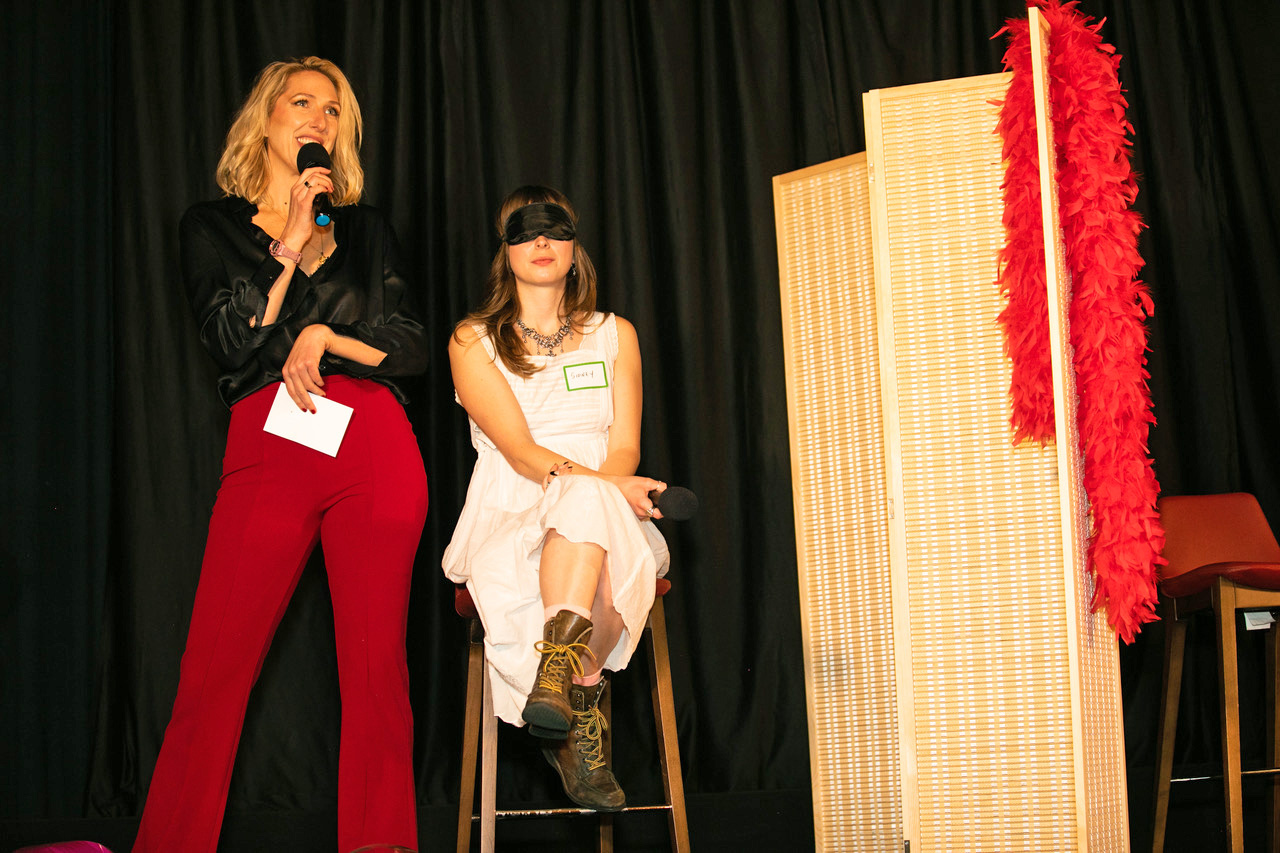
Apparently, everyone looking for love is tired of the apps, because the No Swipe Social interactive dating game, hosted at the Crystal Theatre on Feb. 12, completely sold out. Fresh suitors and contestants rotated for four rounds, culminating in a winning pair at the end of the night. From fun lines of questioning to riotous games — such as a not-my-arms challenge where one partner raced to peel an orange and stuff it in the other’s mouth — made for a lot of laughs and wholesome connections. And not only has the winning duo been on a date since, according to organizer and emcee Aubree Schiesser, but as have several others who attended, including herself. “I don’t know about love right now. It was just last week,” Schiesser told The Sun. “But there are definite interests brewing.”
Tune into Everything Under The Sun on KDNK this Thursday, Feb. 19 at 4pm to hear more about how it went. And stay tuned for the next one by following @no.swipe.social on Instagram
What kind of programming do you want to see the Crystal Theatre Alliance nonprofit tackle?

We'd love to hear what programs or resources in the Roaring Fork Valley or beyond have you found to support you or your child.
As a reminder, this is anonymous. Your name will not be visible, so please feel free to share openly and without worry of judgement.
The candidates to appear on Carbondale's upcoming municipal elections ballot have been announced. What would you like to ask these candidates? Community-sourced questions will be incorporated into our coverage and a live forum hosted at Town Hall (date tbd).
Carbondale Clerk Patrick Thibault drew the order of names to appear on the municipal elections ballot from his “Town Clerk” trucker hat on Feb. 4. On April 7, Carbondale will elect a new mayor as well as three trustees.
The candidates (in the order he drew them) for mayor are Erica Sparhawk and Patricia Savoy; running for three trustee seats are Joanne Teeple, Kade Gianinetti, Colin Laird and Chris Hassig.
What would you like to ask Carbondale's mayor and trustee candidates?

What events and happenings are you looking forward to the most in our local arts community this year?
What upcoming events in your local arts community are you most excited about?
.png)
We're exploring what makes local events meaningful, from trivia nights to volunteer days, and how shared experiences help build connection in Carbondale.
What makes a local event truly “worth showing up for”? Is it the people you run into, the chance to learn or help out, the atmosphere, or simply doing something together on a winter evening?
As we think about creating more of those always-worth-it moments in Carbondale, we’re looking forward to a few upcoming gatherings: Tool Maintenance Day on Jan 29, Trivia Night on Feb 26 at Carbondale Beer Works, and our Season Kick-Off Party in March.
What keeps you coming back to local events? And what would you love to see more of this year?
Making Space for Every Voice - VOICES is working to address a deep and ongoing problem: too many people move through the world without feeling seen, heard, or valued. Through storytelling, creative expression, and community connection, we create spaces where voices that are often overlooked can be shared, honored, and amplified. We believe that when stories are heard, understanding grows and meaningful connection becomes possible.
By Will Buzzerd Sopris Sun Correspondent On Jan. 6, hundreds of Roaring Fork Valley residents gathered remotely, and in person at Carbondale’s Third Street Center, to voice concerns about Harvest Roaring Fork, a proposed 1,500-unit residential community on roughly 283 acres of open space near the confluence of Cattle Creek and the Roaring Fork River. Hosted by a citizen-led opposition group called the Cattle Creek Confluence Coalition, the meeting was organized in preparation for an upcoming Garfield County Planning Commission meeting, during which the development’s fate may be decided. Formerly the Sanders Ranch, the property has faced land-use battles in the past. In 2005, a developer aimed to create an 18-hole golf course, but that met its demise after construction crews disrupted a herd of elk seeking winter habitat and a bulldozer tore down the property’s iconic big red “U76” barn, provoking public outcry. Although a slew of development projects have been proposed by different owners since, the still-undeveloped open space continues to serve as a wildlife corridor for elk, mule deer and other species. The current applicant, Harvest Roaring Fork LLC, bought the Highway 82 adjacent property in the spring of 2024. Harvest Roaring Fork is affiliated with Texas-based development firm Realty Capital, which has already developed over 500 homes and apartments across the Roaring Fork Valley, including the Tree Farm Lofts across from Willits. Harvest Roaring Fork’s big selling point is its prioritization of affordable workforce housing in the midst of a growing housing crisis. Of the 1,500 residential units proposed, 150 would be price capped and deed restricted, in accordance with the 10% minimum required by Garfield County’s Land Use and Development Code. An additional 300 units would be deed restricted and sold only to buyers with full-time employment in Garfield, Eagle or Pitkin County. These extra deed-restricted units would not be required, and thus face no official pricing restrictions. The intent is that ownership of these properties could only be transferred to other locally employed buyers. The developer expects to price these units between $475,000 and $575,000, based on construction cost estimates. For comparison, real estate platforms, such as Zillow and Redfin, estimate the median home-sale price in Garfield County at approximately $615,000. The remaining 1,050 units, marked as “market-rate workforce units,” would not be price capped or deed restricted, and are estimated to cost anywhere between $400,000 to $1.5 million. In addition, Harvest Roaring Fork intends to develop the area into a fully-fledged suburban community, including a village center with 55,000 square feet of commercial space, a 120-room hotel, playgrounds, a childcare facility and a coffee shop within a reconstructed replica of the historic U76 barn. Also present in the application are 325 accessory dwelling units, which, when factored in with the 1,500 regular units and accounting for a 54-acre conservation easement, makes for a development density of 7.96 units per acre. None of the neighborhoods in the surrounding area — including Iron Bridge, Aspen Glen, Teller Springs and Westbank Ranch — exceed a density of one unit per acre. Such unprecedented density has spurred the Cattle Creek Confluence Coalition to strongly oppose the development. Since the project’s proposal, the coalition has been gathering members and donations to defend the 283-acre parcel from what it calls irreversible change. During the Jan. 6 meeting, concerns included increased wildfire risk, light pollution, overburdening existing traffic infrastructure and emergency services, permanent disruption of a vital wildlife corridor and changing the fabric of the Valley’s rural character. The coalition’s leaders picked apart discrepancies in the developer’s traffic assessment, which accounts for fewer hotel rooms, accessory dwelling units and retail spaces than stated in the development proposal. Furthermore, the assessment does not account for construction traffic generated by the project’s estimated 17 to 20 year build out. Even with these reduced values, the traffic assessment estimated a 50% traffic increase on Highway 82. The development would also include two additional stoplights. Attendees at the meeting feared that the resulting gridlock could be disastrous in the case of a wildfire evacuation. The coalition has been collecting resources in preparation for a Planning Commission meeting, originally scheduled for Jan. 28. Due to the applicant failing a public notice requirement, the meeting has been postponed to Feb. 25 at 6pm, and will take place in the Ascent Center at Colorado Mountain College’s Spring Valley Campus.
What do you think about the proposed Harvest Roaring Fork development?